
Eyeshine Experiment
The contents of this page are copyrighted by the Curious Cryptid, all rights reserved.
The information is made freely available for research purposes in the practice of open science.
That makes it available to you, it does not make it yours; link and/or cite if you want to use the information.
This is an ongoing project started 2020-05-14, last updated then to create the page.
Purpose and Justification
Breakdown of the Project
Example Observations
Interpreting Observations
Passive Reflection
Proof of Concept
Purpose and Justification
When I first heard about Sasquatch having glowing eyes, it was from the TV series Finding Bigfoot. I nearly injured myself with the subsequent eyeroll. While laughing at the idea my eyes rolled up so far the optic nerve nearly unplugged from the brain... That was the most ridiculous thing I have heard, at least until someone asked about injection of disinfectants and internal exposure to UV light to cure COVID-19 in humans...
In the last 2019, as I looked more deeply into the puzzle of Sasquatch, I have found that there are people whose opinion and experience I take seriously who are convinced their eyes can glow. I do not question the perception, just the interpretation. I am certain that people have seen something, and I have no doubt they believe it is eyes that glow in the night.
I cannot imagine an evolutionary advantage for having any luminescence internal to the eye for a nocturnal creature. In fact it would clearly be a significant disadvantage, yet I am still confronted with the claim of direct experience of this pheonomnon. Until I see it myself, I have to believe something else is going on; presuming I will eventually see it I will want to understand it more.
From en evolutionary standpoint, the tapetum lucidium is present in some animals. It is a highly reflective layer of tissue immediately behind the retina. This tissue reflects light not absorbed by the retina back into the retina, effectively nearly doubling the light sensitivity of animals with this.
No primate has a tapetum lucidium. I have no doubt of the perception of eyes actually glowing with an internal light source, and I cannot resolve this cognitive dissonance. Instead of simply dismissing the notion, I want to experiment around it.
Certainly some experiment is justified. This is a highly unusual claim and represents an unprecedent phenomena that needs to be understood.
Project Breakdown
Experimentally, there is no point it putting something that glows out in the dark to see if someone observes it - of course they will see it.
Presuming it was eyes being seen, the only rational experiment would be to try and make a passive model of the eye and ask some who have observed eye-glow to evaluate passively reflected light in comparison.
I can offer no alternative explanation at this stage, so observation and collection of data are the only options.
.
.
Example Observations
I have no personal experience seeing this. Nobody I have met personally as of May 2020 in this exploration of Sasquatch claims to have seen it.
I have read through descriptions of this phenomena. I am not at all convinced the glow that is seen is actually eyes. However the perception is based in part on having two sources, and undeniably eyes tend to come in pairs. This is interesting, perhaps compelling, but not yet convincing.
One description has a small group of experiencers1 observing several pairs of eyes in the forest while one or more pair seem to rotate (slowly, vertically) around each other. In order to see this from a pair of eyes, the owner of said head would have to climb around in some sort of circle, presumably keeping their eyes at roughly a uniform elevation the whole time.
I suppose an adult could lift and turn a smaller one to achieve this effect, maybe done for the amusement of the younger one? This is strange and deserves some attention at an appropriate stage of the analysis of results.
This suggests to me that it is possible multiple things are being observed; the greatest clue is the rotating eyes. I am reasonably certain that a witness saw this happen (ie not a hoax claim), and I take that description as evidence that what was seen was probably not eyes. I do not know what it was, but I have significant doubt that it was eyes.
Interpreting Observations
The debate, as they say, is eyeshine vs eye-glow. However, that statement dismisses any other possibility, not that I have one to offer. The only similar phenomenon that may provide explanation is orbs, but these orbs would need to occur in pairs to provide observed behavior; lets put orbs on hold for later...
The fact that there is debate here means that people who have seen both what they believe to be eyeshine and eye-glow cannot clearly distinguish the phenomena. In general one light source must be at least twice as bright as another for a human to perceive a difference between them. I pose a preliminary conclusion that both phenomena are comparably bright since nobody in the field has made the statement that eye-glow is so bright (or so dim) it is clear and distinct from eyeshine - otherwise there is no debate to be had.
From what I can discern reading about it, the case for eye-glow is an apparent lack of available ambient light to provide a source for the reflective eyeshine. Let's consider what is necessary for eyeshine to be observed:
As the observer you must be looking at the eyes of the subject. The subject must be looking directly at you. If they are not then the optical path for the light you observe does not provide enough reflection from the back of the eye, with or without a tapetum lucidium. There must be a source of light to be reflected from the subjects eyes to yours.
As an engineer, I have a problem with the term ambient light here. I suggest that no ambient light is required in the area of the observer, thus the observer need not perceive ambient light at all. There does need to be a source of light, of course, but consider its nature.
Let's start with the case where the observer perceives ambient light. They observe this by being able to perceive their surroundings without an additional light source. This is because light, most probably from the sky, is being scattered2 from things surrounding the observer and some of the scattered light reaches the eyes of the observer with enough intensity to be perceived. This may be starlight, moonlight, or light from surrounding cities, towns, and houses.
This scattered light is also reaching the eyes of the subject which is also watching the observer, and reflected to the observer. This allows some of that light to also reach the observers eyes with enough intensity to be perceived.
What is important for this to work is that a source of scattering of light be nearly inline with the optical path from the subjects eyes to the observers eyes. That source does not need to be surrounding the observer. The observer could be standing in effective total darkness.
There could be an opening in the trees between the observer and the subject, or merely sparse enough cover to permit enough accumulative light to be available. There could be an opening in the trees behind the observer sourcing the light, as well.
Once the observer has detected those eyes in the dark, how likely are they to turn their back on those eyes to see if there is an opening in the trees behind them. I think generally quite unlikely, even though a tactical review of the situation is more than warranted to make sure there are not more eyes behind them...
Thus my first speculation is that the phenomenon is simply eyeshine, and that the source of light is simply not apparent between the observer and the subject.
I am setting aside strange observations such as the rotating eyes for now. I do not dismiss those observations, but I strongly question if that was actually eyes. It might be explained by a behavior along with mundane eyeshine, or it may be something else we do not have enough information to understand.
Passive Reflection
Given the unprecedented conjecture of glowing eyes or the presumption that something we do not understand is going on, I must go with the latter - but I offer that glowing eyes is something we absolutely do not understand and may be a possibility.
The phenomena of eyeshine is relatively common, while pronounced with a tapetum lucidium, it does not require one to observe eyeshine. This is the best natural precendent to start with. The first thing I want to determine is whether any passive reflection can be as bright as the perceived eye-glow.
The first round of the experiment will be making a model of the eye. This model will be backed by various reflective materials.
I propose high albedo materials be suspended behind a model for the lens of the eye. A tapetum lucidium would be effectively a silvered mirror. For this I would propose the use of mirror-finish paint, silver paint, and/or aluminum foil. There are paints available today that can be applied to the smooth and clean back of a sheet of glass to make a quality mirror using spray paint. Metallic silver, or even chrome paint, is too dull to provide this effect.
Materials that have come to mind include glass beads, reflective safety tape, and titanium dioxide which is a typical pigment for white paint.
There is precedent for some biological materials to flouress under UV light. I consider the possibility that UV light, not particularly visible, can stimulate flourescence in such materials in or around the eye. A sample of floursecent dyes seem in order to indicate the presence of UV light. While this is technically an exchange of energy, under the circumstances I consider it to be passive in nature because it is the re-emission of a different wavelength of light, not the generation of light.
1 - The term experiencers is used to describe a group of people, often guided by a researcher or researcher group, who are interested in the experience of looking for bigfoot, but not always (or even often) interested in a committment of time or effort to conduct actual research. This experience is reported by the researcher guide.
2 - Unless an object actively emits light, all objects you see are visible due to the scattering of light off the object from another source. When you shine a flashlight into the darkness, some of the light may touch objects in the darkness and those objects scatter that light, some of that scattered light reaches your eyes and you see those objects...
Proof of Concept
The first stage of the experiment must be a proof of concept where the model is prototyped and experiments are done to deterimine if it is functional.
The most significant problem in this experiment is the need for the subject to be looking directly at the observer for the eyeshine to be optimal. It is not practical to have an active tracking servo, so mounting the models facing the observer in advance is required.
The human eye is roughly 1 inch in diameter. Based on Mitchel Townsend's research of dental impressions3 the eyes (like the teeth) should be about twice the dimensional size. A full model of the eye would probably begin with a 2 inch spherical resin mold form.
I speculate a full model is not required, however. I mean to reproduce the approximate size of the iris of the eye. Being at night I pose the iris will effectively be fully dialated. A reasonable approximation of this should be 1" glass cabochons4 to provide a rounded exposed surface and a relatively flat back and are under about a quarter inch deep.
A full model would require much more precise direction pointing to the observer. I expect the cabochons will be much more forgiving for this, allowing a wider field of view. The potential cost of this is less of the light reflected directly along the line of sight.
I have designed a fixture for mounting the cabochons with a backing. I used trimble
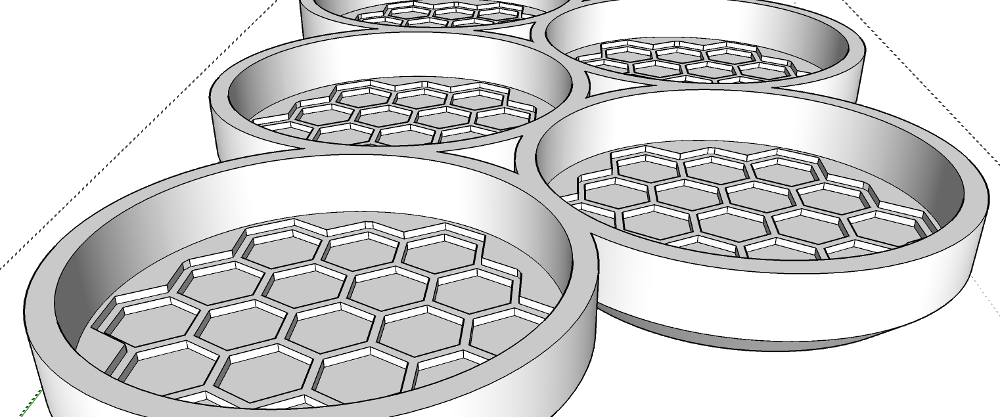 sketchup for this. In the first couple experiments assembling a model, I found that dropping in the cabochon would displace much of the resin with material; I want to cure the resin against the back of the glass.
I decided to design a shallow honeycomb grid and a shallow standoff on the edge to ensire that backing is not compressed out of the model when the caboshon is dropped in. Both the grid and the standoff are only 1/2mm deep, but with glass beads and powders this allows the material to pack behind the glass. With resin this allows the resin to comply to the back of the glass without being completely displaced. It makes little difference with the reflective tape, but with foil the honeycomb forms craters which may allow a wider field of view with glints along the edges; I am not sure if this will make it more visible or disperse the reflection.
sketchup for this. In the first couple experiments assembling a model, I found that dropping in the cabochon would displace much of the resin with material; I want to cure the resin against the back of the glass.
I decided to design a shallow honeycomb grid and a shallow standoff on the edge to ensire that backing is not compressed out of the model when the caboshon is dropped in. Both the grid and the standoff are only 1/2mm deep, but with glass beads and powders this allows the material to pack behind the glass. With resin this allows the resin to comply to the back of the glass without being completely displaced. It makes little difference with the reflective tape, but with foil the honeycomb forms craters which may allow a wider field of view with glints along the edges; I am not sure if this will make it more visible or disperse the reflection.
3 - Bigfoot is Solved Hybrid Hominin based on Forensic Dental Impression Research.
4 - Glass Dome Cabochons to model the lens of the eye.
