Parabolic Microphone Project
The contents of this page are copyrighted by the Curious Cryptid, all rights reserved.
The information is made freely available for research purposes in the practice of open science.
That makes it available to you, it does not make it yours; link and/or cite if you want to use the information.
This is an ongoing project started 2020-05-19, last updated then to create the page.
Purpose and Justification
Breakdown of the Project
Purpose and Justification
R1H1 makes significant use of parabolic microphones to determine the relative location of activity. They are placed with recorders, and sometimes cameras, and left for typically not more than a day or so. They are not typically used live, so the subjects have apparently not figured out what they do. The parabolics do get investigated with what I would describe as a form of counting coup where they approach and touch or tap with a stick or throw a pine cone or small stone and retreat.
To this end I am not going to be using one live, at least not in RR12 to clue them in.
The parabolics used by R1H are roughly frisbee sized. I know parabolics are functional3, so this project does not research their efficacy. I will be looking to what microphones might be used most easily with a dish, and how to not spend upwards of $500 and more for a good arrangement.
1 - R1H is the name abstraction for the host of our research region 1
2 - RR1 is the location name abstraction our research region 1
Project Breakdown
I could make a form to vacuum mold parabloic dishes upwards of 24 inches in diameter. However the cost of tooling that up would be about as much as buying a single dish with a well designed AMP for it. I can buy the dish only from wildtronics4 for just around $200 including shipping.
I need to mount it to a tripod and connect it to a recorder. For me, this much of
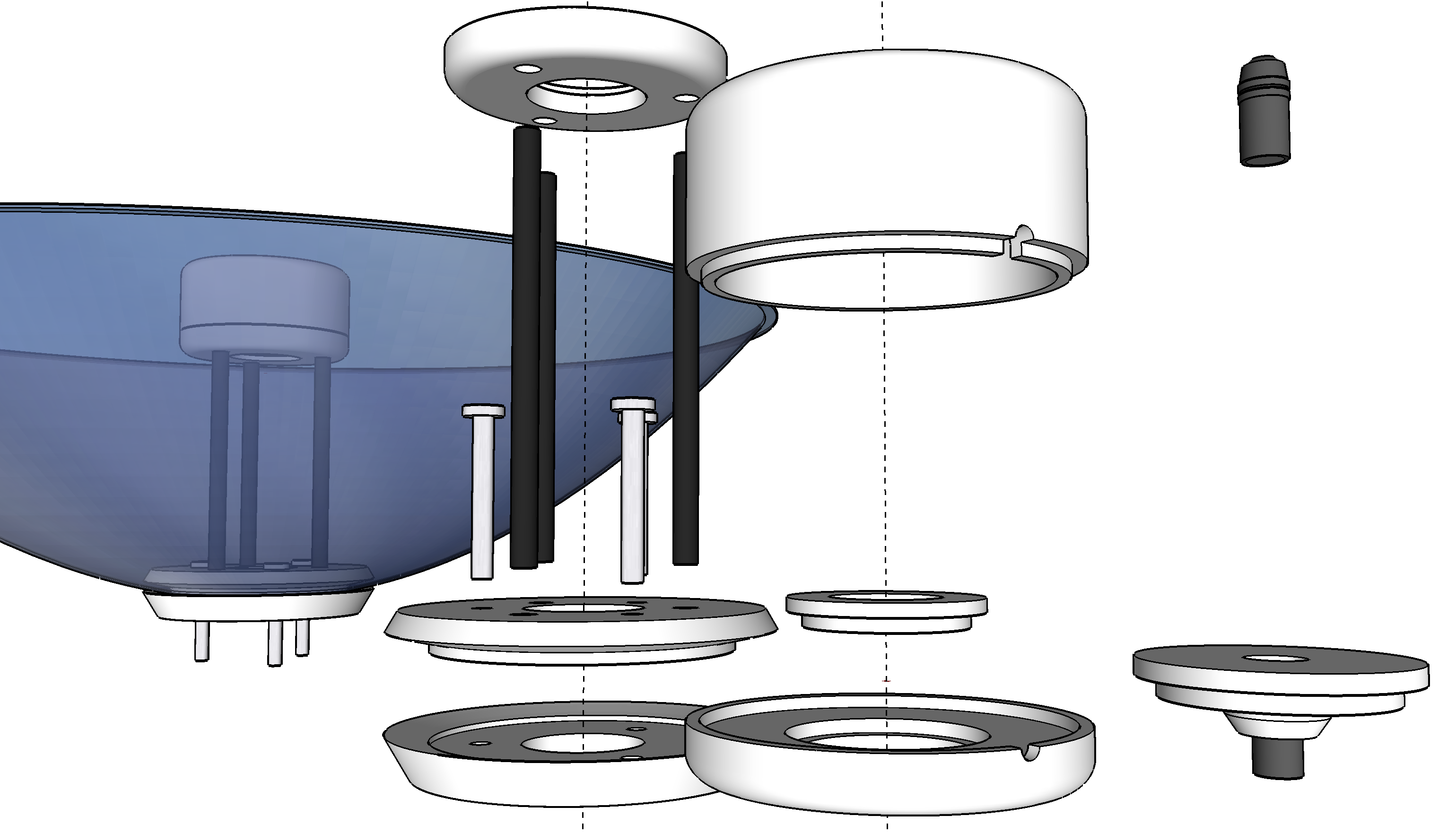 the project is essentially free and fun to do. I will 3D print the mount to the middle of the dish, use carbon-fiber arrow shafts as standoffs to the microphone, 3D print an enclosure for the microphones to try out, and 3D print adapters for any microphone I want to try out to fit them to the enclosure with the microphone open to the focal point of the dish.
The first plan, in the picture to the right, will use a cardioid lapel microphone I can attach directly to the Zoom H6 digital recorder I am using to monitor the base camp area. In this case the Zoom H6 will provide basic signal amplification. There is accomodation for the microphone cable from the enclosure through the mount pieces to the recorder.
This is just a first pass at the project. I may end up wanting to do this differently, such as mounting an Olympus DM-720 in a different enclosure.
I might end up wanting to build an amplifying circuit into the enclosure with gain adjustment there. Or a wireless Microphone.
This leaves me with a very flexible solution for experimenting with the sound capture while keeping the basic platform consistent. I can make a different enclosure cover to accomodate an amplifier and transmitter, or most anything I can imagine.
4 - Parabolic Dish Polycarbonate 0.06in thick 22in diameter.
